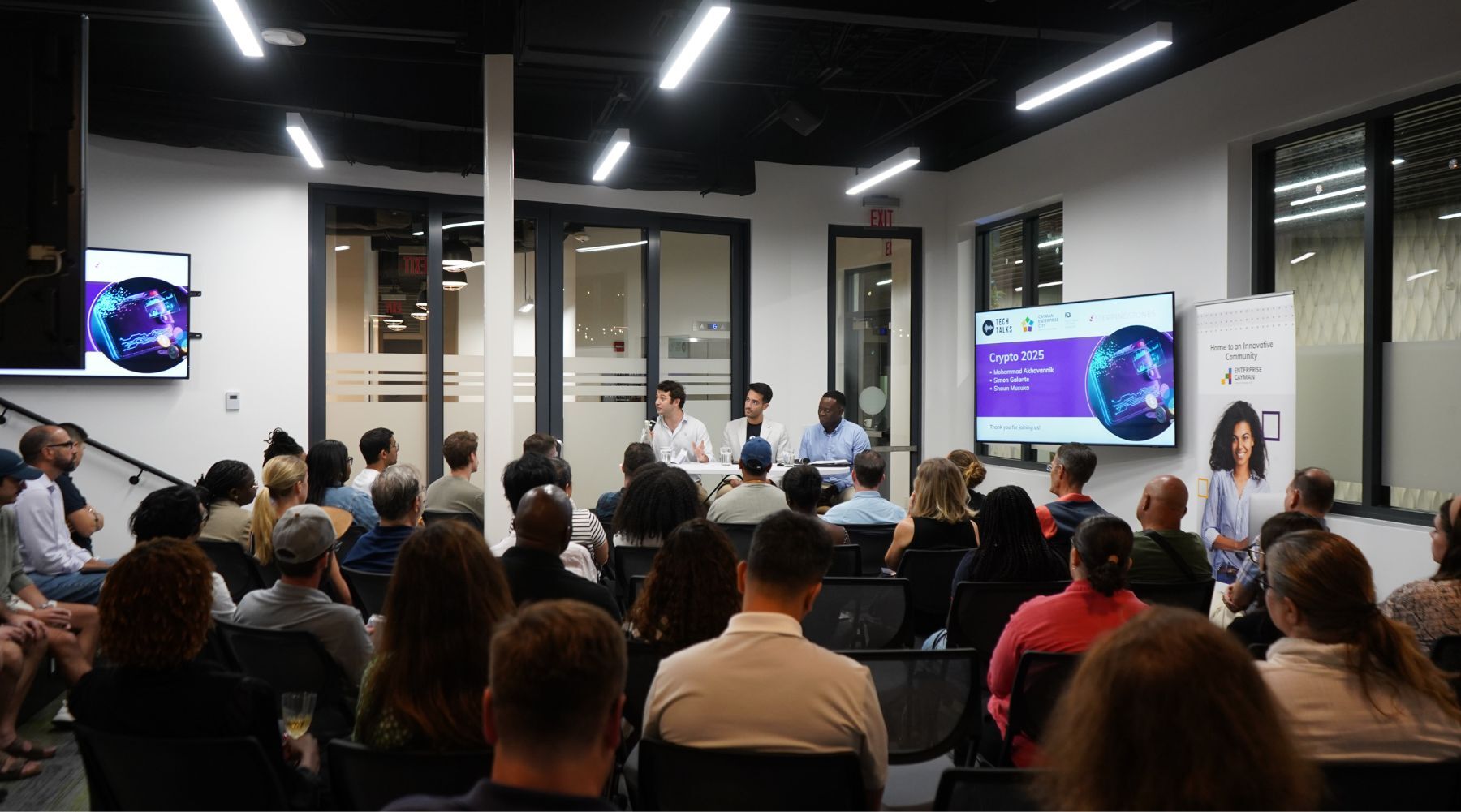
As the sector moves beyond experimentation and into a more deliberate phase of building, founders are thinking more carefully about where they want to base their teams, grow their networks, access capital, and build for the long term. The conversation is no longer just about where a structure can be established. It is increasingly about where a business can operate with the right support, relationships, and community around it. That shift was a clear theme throughout Cayman Enterprise City’s webinar, Where the Next Protocols Are Built: Why Web3 Teams Are Choosing Cayman, hosted in collaboration with the Cayman Islands Virtual Assets Society (CIVAS).
Where Community, Access, and Execution Influence Founder Choice
Over the past several years, founders and protocol teams have become more strategic in how they think about jurisdictional choice. Cayman continues to be well understood as a serious base for digital asset and Web3 activity, but what stood out in the discussion was that the appeal of Cayman is increasingly about what becomes possible once a team is actually operating there.
“The crypto space has changed a lot and is much more established, more focused on long-term positioning, and more connected to RWAs and TradFi. I would argue that today the Cayman Islands is even more well-positioned for crypto-related ventures.” - Mario Yaksetig, Cryptographer at BitFashioned SEZC
Sector maturity changes the decision-making framework for founders. It places greater weight on practical execution, speed of collaboration, access to investors, and the quality of the ecosystem surrounding a team.
Why Ecosystems Matter for Protocol Teams
For protocol teams in particular, the value of an ecosystem is not abstract. It affects how quickly ideas can be tested, how easily partnerships can form, how product and governance decisions are informed, and how efficiently teams can access the people they need.
Speaking from the perspective of a technical operator, Mario explained that many serious teams underestimate the depth of the Web3 community already present in Cayman. He noted that founders and engineers are not merely choosing a jurisdictional framework here; they are entering an environment where they can engage directly with builders, operators, and protocol teams already working at a very high level.
As he put it, “I can literally just walk upstairs and brainstorm right away with dev teams from some of the top 50, even top 100 companies.” He added, “the iteration speed you can have is insane.”
For founders, that kind of proximity matters. The ability to pressure-test a product concept, speak with engineers who have already solved adjacent challenges, or access experienced operators without friction can materially improve execution.

Community as Infrastructure: An Operating Advantage, Not an Add-On
One of the clearest takeaways from the discussion was that community should not be viewed as a soft benefit that sits adjacent to the business. For strategic founders, community forms part of the business infrastructure itself.
“At Cayman Enterprise City we’ve deliberately built a very vibrant, very active, and interesting community. That matters because when teams relocate, they are not arriving in isolation, they are stepping into an ecosystem that can help them connect, integrate, and build more quickly.” - Charlie Kirkconnell, CEO at Cayman Enterprise City
CEC now supports more than 450 Special Economic Zone (SEZ) companies, with roughly 30 percent operating in the blockchain, Web3, and virtual asset space, and hosts more than 200 events and happenings each year. The CEC ecosystem enables founders to benefit from repeated interactions, knowledge-sharing, specialist events, and the ability to build trust over time.
The value of CEC’s community model lies in giving global teams access not only to advisors and service providers, but also to peers, collaborators, and counterparties who understand the realities of building in Web3.
Access to Capital and Relationships That Compound
For Yaroslav Pshenitsyn, Partner at Intrinsic Capital SEZC, one of Cayman’s most compelling attributes is the quality of access it offers. Speaking about the practical fundraising environment for builders, he noted that Cayman offers a different kind of proximity to capital than many larger markets. In his view, access in Cayman is often more direct, more relationship-driven, and more likely to lead to meaningful follow-through when the underlying project is strong.
“In Cayman, investor interest tends to be more genuine and more likely to convert into real follow-through. For founders with the right mindset, strong technology, a credible team, and a clear roadmap, the relationships built here can be exceptionally valuable, and difficult to replicate elsewhere.” - Yaroslav Pshenitsyn, Advisor at Chainlink SEZC and Partner at Intrinsic Capital SEZC
In larger centres, there may be more capital and more market activity, but also more noise and more distance between the right people. In a concentrated and well-networked environment like Cayman Enterprise City (CEC), introductions can happen faster, trust can develop more naturally, and momentum can build in a more practical way.

CIVAS and the Importance of a Builder-Led Community
Another important feature of Cayman’s ecosystem is that the Web3 community is not only active but organised. During the discussion, both Mario and Yaro emphasised the role of the Cayman Islands Virtual Assets Society (CIVAS) in supporting builders, facilitating connections, and helping ensure that technical and operational perspectives are represented in the broader conversation.
Mario explained that CIVAS was created to help bridge the gap between what builders need and what regulation is providing, particularly in a market where technology evolves faster than most policy environments can reasonably keep pace with. He described CIVAS as a platform through which “the actual builders of some of the biggest DeFi protocols, the builders of some of the biggest L1s, managers of some of the biggest funds in the space” can contribute insights, support ecosystem development, and help newcomers connect with relevant participants. He also noted that when a new project arrives in Cayman, CIVAS can often facilitate introductions quickly and meaningfully.
Yaro reinforced that point, saying that CIVAS is “one of the top groups founders can go to for genuine access” if you are raising capital, building applications, or forming partnerships within Web3 and fintech.
The strongest ecosystems are not only well regulated or well serviced, they are ecosystems in which builders can actively participate, contribute, and help shape the environment around them.
Serious Teams Choose Ecosystems, Not Just Jurisdictions
For protocol teams evaluating where to build from, Cayman’s appeal increasingly lies in the combination of jurisdictional credibility, practical accessibility, and a vibrant community that is already deeply engaged in the work of building.
If you are considering Cayman as a base for your team or protocol, CEC’s Global Mobility Team can help you explore what a practical Cayman operating model could look like for your business.
Disclaimer: This article is provided for general information purposes only and does not constitute legal, regulatory, tax or other professional advice. Specific advice should be obtained from suitably qualified advisors in light of your particular circumstances, business model and regulatory perimeter. No liability is accepted for reliance on the contents of this article.